A guide for Visa employees
Working at Visa, living near the Foster City campus
You got the job, or the transfer, and now the real question lands: where should you live? This page answers it fully for Visa's technology and product campus in Foster City. The four areas, the drive from each, what homes cost, how the schools sort out, the money, and the road from first tour to keys, all in plain words, all on one page.
I am Simon Sahi, a real estate agent with Signature Properties here in Silicon Valley. I help people buy and sell homes in the towns around this campus every week, and I built this page so a Visa employee can sit down once and understand the whole picture.
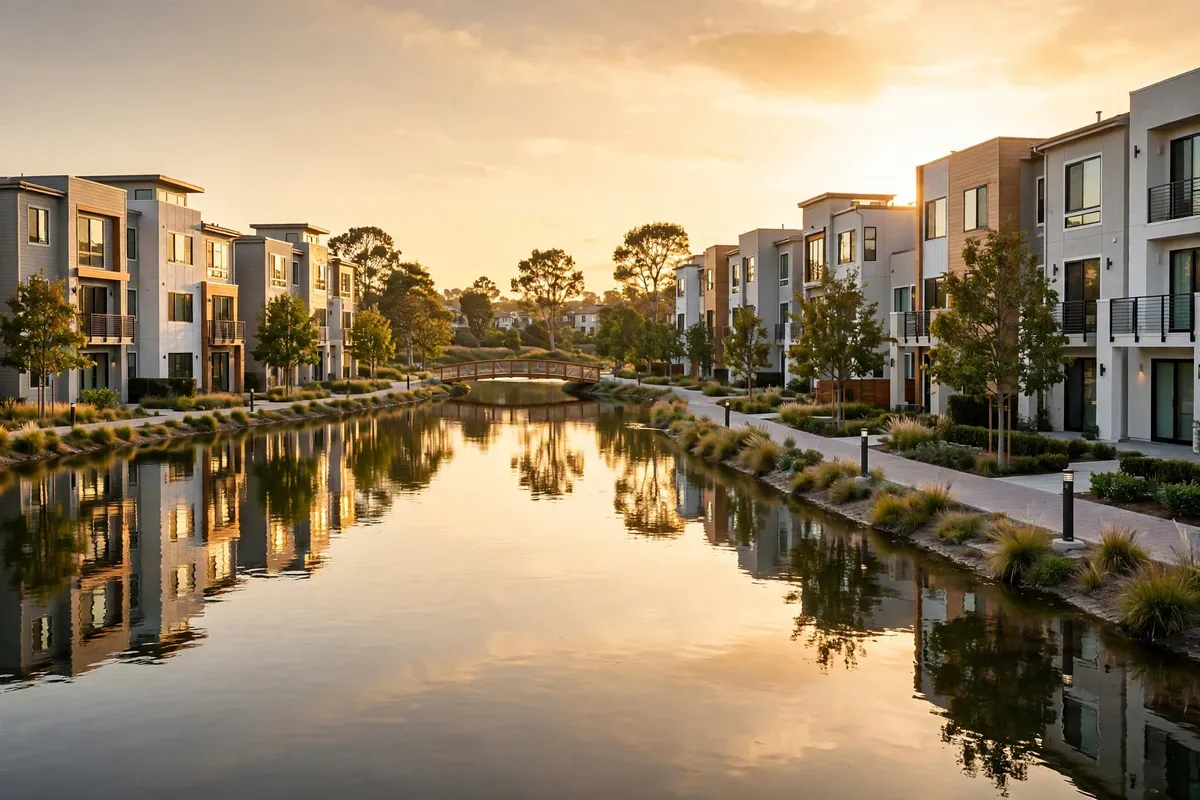
The campus stands in Metro Center in Foster City, a town built on lagoons, a short run from the neighborhoods on this page.
Who this page is for
Short answer: anyone at Visa choosing where to live near the Foster City campus, whether you arrive next month or next year.
This page was written for you if:
- You are a new hire moving to the Bay Area and starting from zero.
- You already work at Visa and rent nearby, and you are ready to own.
- Your role could sit at Foster City or at the San Francisco headquarters, and you want a home that keeps both doors open.
- Your family is arriving from another state or another country and needs the full picture in one sitting.
One honest note before we start: Foster City is Visa's great technology and product campus, and it is not the company's global headquarters. Visa moved its headquarters to Mission Rock in San Francisco, where its Market Support Center opened in June 2024. Some Visa roles sit there, not here. This guide is for the Foster City campus: if your offer names Foster City, or your team works on the product and technology side, this is your page. If your role sits in San Francisco, tell me, and we will weight the map toward the rail line and the north.
How to use this page: every section opens with the plain answer, then gives the detail under it. Read the short answers for the whole story in five minutes, or settle into the sections that matter to you. When a question is yours alone, call me and we will work it through.
The short answer
Short answer: San Mateo for the shortest run and the only rail station of the four, San Carlos for the family main street and strong schools, Redwood City for the widest choice and the downtown energy, and Menlo Park for the schools and the prestige at the highest price of the four.
- Shortest run, the rail town: live in San Mateo. The campus is minutes up the boulevard, and Hillsdale station puts Caltrain in your town for the rest of life.
- The family main street: San Carlos. Laurel Street, staged school districts families aim for, and a steady run north to the campus.
- The widest choice: Redwood City. Every kind of home the Peninsula builds, a real downtown, and Caltrain on its main street.
- The schools and the prestige: Menlo Park. The names families move for, at the highest prices of the four and the longest drive of the four.
Foster City itself deserves a word before the four areas: it is a fine place to live, all lagoons and levees, and many Visa households choose it. It has no city page of its own in this series yet, so its picture is told inside this page, in the money section and the questions, and the four areas below are the towns around it with full guides of their own. The rest of this page proves each line of the short answer, area by area, number by number.
The four areas compared
Short answer: all four areas work for campus life. They differ in price, schools and feel far more than they differ in minutes, and every one of them beats the campus's own town on one thing Foster City cannot offer: a rail station or a main street of its own scale.
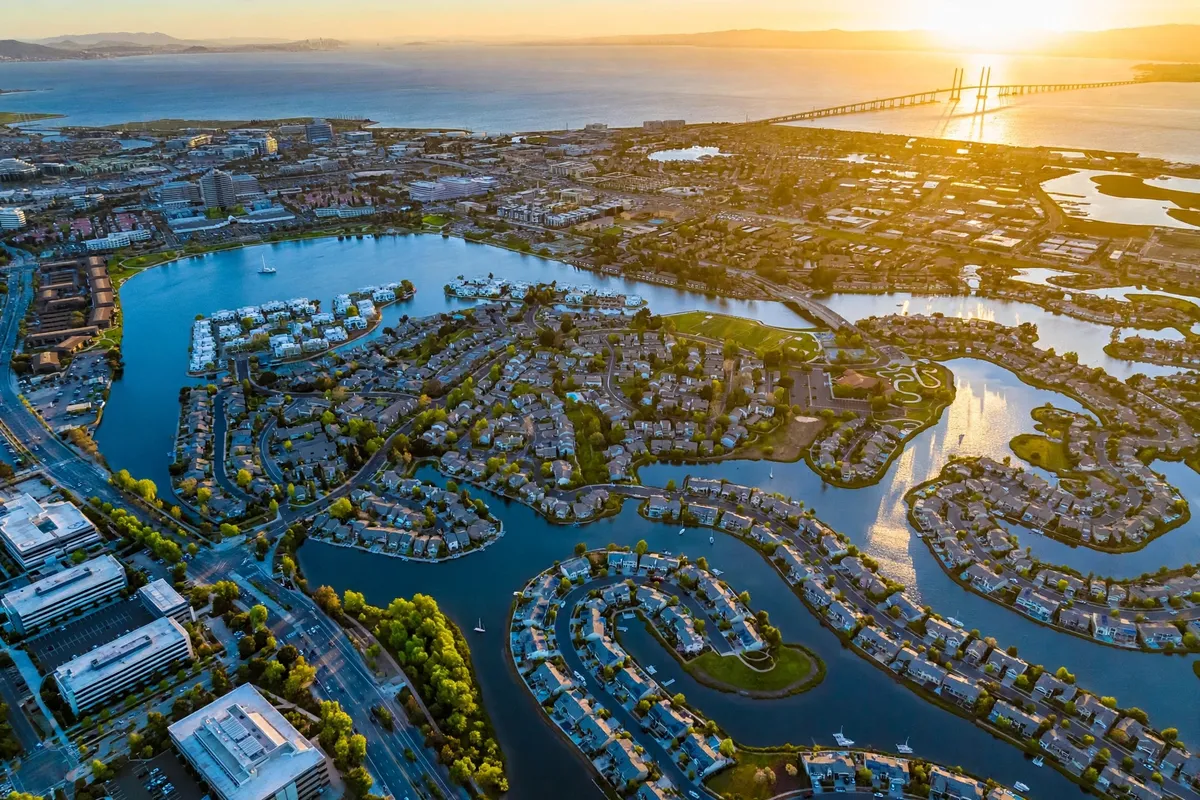
Foster City sits between San Mateo and the bay, with the bridge as its east door and Highway 101 as its west one.
| Area | Morning drive at peak | Drive off peak | Median price | Single family median | In one line |
|---|---|---|---|---|---|
| San Mateo | About 15 to 25 minutes | About 10 to 15 minutes | About $1.57M | About $2.38M | The campus's own neighbour, with Hillsdale Caltrain in town |
| San Carlos | About 25 to 40 minutes | About 15 to 20 minutes | About $2.48M | About $2.50M | Laurel Street and staged districts families aim for |
| Redwood City | About 25 to 45 minutes | About 15 to 25 minutes | About $1.90M | About $2.35M | The widest choice of the four and a downtown with a pulse |
| Menlo Park | About 35 to 55 minutes | About 20 to 30 minutes | About $2.95M | About $3.15M | The school names and the prestige, at the highest price of the four |
Drive times are typical ranges in a car from the middle of each area to the Metro Center campus, and they stretch on rainy days and school mornings. Prices are approximate medians from Redfin for all home types across the three months ending September 2026. The single family median column gives the median for houses alone in October 2026 from RE Report figures, a different month and publisher from the other pages in this series, because the county association's September city figures could not be verified and none is invented here. For county context, the California Association of Realtors put the San Mateo County single family median at about $2.33M for September 2026.
San Mateo
The campus's own neighbour: the shortest run of the four, a real downtown, and the Caltrain station the whole corridor uses.
The drive. About fifteen to twenty five minutes at peak up Fashion Island Boulevard and Metro Center Boulevard, or on 101 and 92, and ten to fifteen minutes off peak. The eastern neighborhoods sit closest: from the streets around Hillsdale and the bay side, the campus is a surface street run that barely touches a freeway.
The homes and prices. Everything from bay side condos to the grand streets of San Mateo Park and the family neighborhoods around Hillsdale. The citywide median sits at about $1.57M across all home types, the lowest of the four, and single family homes alone median about $2.38M on October 2026 RE Report figures. The spread between those two numbers is the story of this city: a deep condo and townhome rung under a strong house market.
The schools. The San Mateo Foster City district serves the younger years, and the San Mateo union high school district the older ones, with Hillsdale and Aragon the high schools most eastern families read to, and San Mateo and Burlingame High serving the north of the city. One city, two systems, several answers: verify by exact address.
The feel. The most complete town on this page: a downtown of restaurants and a beloved old theatre, Central Park, the Hillsdale shops, and bay shore parks at its east edge. It lives like a small city, because it is one.
Who it suits. Anyone who wants the shortest day and a town that does everything, from first time Peninsula buyers to families who plan to stay, and train riders who want Hillsdale station in their lives.
San Carlos
The family main street town: Laurel Street, staged school districts, and prices that say how chased it is.
The drive. About twenty five to forty minutes at peak on 101 north and 92, or up the boulevard through Belmont, and fifteen to twenty minutes off peak. The run is steady rather than fast, and San Carlos households here plan around the 101 peak the way valley households plan around Lawrence Expressway.
The homes and prices. Family streets of ranch homes and storybook houses climbing gentle hills, with a thin condo rung near the station and El Camino. The citywide median sits at about $2.48M across all home types, and single family homes alone median about $2.50M on October 2026 RE Report figures, the tightest pair of numbers on this page, which tells you how house led and how chased this town is.
The schools. The San Carlos district serves kindergarten through eighth grade inside the town lines, then the Sequoia union district for high school, Carlmont for most of the town and Sequoia High for its southern slices. It is the staged pattern Peninsula families know well: a prized first stage, then a boundary to check for the second.
The feel. The city of good living, by its own old motto, and it earns it: Laurel Street's cafes and wine bars, a farmers market, hillside trails above the town and a calm that deepens street by street.
Who it suits. Families who put the main street and the schools first and accept a steady mid length run to the campus as the price.
Redwood City
The widest choice of the four: a downtown with a pulse, Caltrain on its main street, and neighborhoods at every level.
The drive. About twenty five to forty five minutes at peak on 101 north and 92, and fifteen to twenty five minutes off peak. Redwood Shores, the town's bay side district, sits closest of all its neighborhoods, up the boulevard from the campus with no freeway in the run at all.
The homes and prices. Downtown condos, the family streets of Mount Carmel and Edgewood Park, eichlers, foothill homes in Emerald Hills, and the lagoon townhomes of Redwood Shores. The citywide median sits at about $1.90M across all home types, published as a round figure by its source, and single family homes alone median about $2.35M on October 2026 RE Report figures.
The schools. The Redwood City district serves the younger years in most of the city and the Sequoia union district the high school years, Sequoia High and Woodside High by address. The trap on this page lives here: Redwood Shores addresses answer to the Belmont Redwood Shores district for the younger years, not to Redwood City's own. The neighborhood name never answers the school question. The exact address does.
The feel. A county seat with a real downtown: the courthouse square, the theatre, the library, a food scene that punches above its size, and the bay trails at the Shores. Evenings here feel like a town, not a suburb.
Who it suits. Buyers who want choice at every level, train riders who want Caltrain on the main street, and Redwood Shores households who want the water at the door and the campus up the boulevard.
Menlo Park
The prestige end of the corridor: the school names families move for, village calm, and the highest prices of the four.
The drive. About thirty five to fifty five minutes at peak on 101 north and 92, and twenty to thirty minutes off peak. It is the longest run of the four by a clear margin, and Menlo Park households here make it for the schools and the setting, with the campus's hybrid pattern, two to three office days for many roles, softening the weekly total.
The homes and prices. Village streets west of El Camino, family neighborhoods in the Willows and Belle Haven at the east, and estates toward the Atherton line. The citywide median sits at about $2.95M across all home types, the highest of the four, and single family homes alone median about $3.15M on October 2026 RE Report figures.
The schools. Three systems meet in this one small city. The Menlo Park city district serves the west side's younger years, Ravenswood serves the east side, and Las Lomitas serves the southern slices, then the Sequoia union district for high school, Menlo-Atherton for most of the town. No area on this page rewards the address check more.
The feel. A village that grew into a small city: Santa Cruz Avenue's cafes and bookshop, the farmers market, oak shaded streets, and the bay shore and Bedwell Bayfront Park at its east edge for the evening walk.
Who it suits. Senior hires and established families who put the schools and the setting first and accept the longest drive of the four as the price of them.
Getting to campus
Short answer: Foster City has no rail station, and this page will not dress that up. Most people drive a short boulevard or freeway run. The working transit pattern is Caltrain to Hillsdale and a bus for the last leg, and the levee trails make the bike a real third option.
The rail truth, and the pattern that works
No train stops in Foster City: not Caltrain, not BART. Any page or listing that calls a station your campus stop without naming the last leg is reading the map too hopefully. The nearest Caltrain station is Hillsdale in San Mateo, and the pattern that works is Caltrain to Hillsdale, then SamTrans Route 251, the Foster City circulator, which runs from the station through the Bridgepointe side of town to Metro Center and along the boulevard the campus stands on. The bus runs about hourly, so it rewards a household that plans its mornings, and the station sits in San Mateo, which is one reason that town leads this page.
BART's nearest ground is further north still, at Millbrae and San Bruno, with a bus or a drive beyond it. For a Peninsula life the Caltrain pattern is the one to build on. For the East Bay, the bridge and the drive are the honest answer, or the ACE and Capitol Corridor trains to the valley side and a second leg from there.
By car: the two doors
Foster City has exactly two road doors, and every commute here uses one of them. From the west and south, Highway 92 leaves 101 at the Hillsdale exit and runs straight into Metro Center, where the campus stands. From the East Bay, the San Mateo Bridge, about seven miles of it, lands at the same door. Inside the town, the boulevards are wide and the run from the bridge or the freeway to the campus is minutes.
The peak pinch points are the 92 and 101 interchange and the bridge's morning build, and the areas above are ranked with those in mind. One more honest note: no shuttle to this campus could be verified from any public source, and this page will not promise one. If your team runs one, it lives on Visa's internal pages. Ask in your first week, and tell me what you learn, because it can change which side of the bay a home should sit on.
By bike
The levee is the cyclist's gift here. The Bay Trail runs on the levee tops around Foster City and ties the town south to Redwood Shores and Belmont and north through San Mateo's shore parks toward Coyote Point. From Redwood Shores the ride to the campus is short and almost entirely on paths, and from the San Mateo bay side it is a longer, beautiful commute that real riders here make daily. The bridge itself carries no bikes, so the East Bay side stays a drive.
The hybrid pattern
A word on the working week, because it shapes how far away a home can sit. Visa's own job postings describe the pattern in the company's words: two to three set office days a week for many roles, with a guidepost of spending at least half of your time in the office, and some teams at three days. There is no single company page that settles it for every role, so ask your hiring manager for your team's actual days before we draw the search map. Two or three office days forgive the Menlo Park run in a way five never will.
The money picture
Short answer: the gentlest starting point of the four is San Mateo, and Foster City itself hides a lesson in its numbers: a low looking all homes median that is really a town of condos and townhomes standing beside strong house prices. Wherever you land, plan the whole cost of owning, not just the purchase price.
What homes cost by area
In round numbers, from Redfin figures for the three months ending September 2026: San Mateo starts the four at a median of about $1.57M, then Redwood City at about $1.90M, San Carlos at about $2.48M and Menlo Park at about $2.95M. Single family homes alone, on RE Report figures for October 2026, run about $2.35M in Redwood City, $2.38M in San Mateo, $2.50M in San Carlos and $3.15M in Menlo Park. Foster City itself tells the mix story plainly: its all homes median sits near $1.3M on the same Redfin series, pulled down by its many condos and townhomes, while a home value index for the town stands near $1.85M and its single family homes trade in the low to middle two millions. A median is a middle marker, not a quote, so before any offer we price the real home against the recent sales on its own street.
Buying while paid partly in stock
At Visa, as across the valley and the payments world, a real share of pay can arrive as stock that vests over time rather than as salary. Lenders here understand that shape of pay because they see it every working day. In general terms, they study your base salary, your bonus pattern, and the record of stock that has already vested and landed across the past couple of years, and they treat a steady vesting record as part of your income picture. Stock that has not vested yet generally counts for less than stock that has a history of landing.
So build one folder early: your offer letter, your pay records, and your vesting schedule. Put the whole picture in front of a lender who works with tech pay before you fall for a home, not after. One more honest note, said plainly because it belongs in a decision this size: Visa reduced its workforce during 2026, with a state filed round at this campus in the autumn among them, as most large employers here have at some point. A household buying on one Visa income does itself a favor by keeping a reserve after the down payment rather than stretching to the last dollar. This is general education only, never a promise about any loan. Your own numbers will decide what you can carry, and a straight talking lender will lay them out plainly.
Renting first or buying first
Renting first suits you if you are new to the Bay Area and want a season of living here before a decision this size, if your role might sit in San Francisco rather than Foster City and you want that settled first, or if a large share of your pay lands later in the year and you want it counted at full strength.
Buying first suits you if you already know the Peninsula, if your family wants one move and then roots, or if you would rather build your own equity from the first month than pay a landlord through a long search.
Neither order is the right one for everyone. What protects you is choosing on purpose, with the numbers in front of you, instead of drifting into whichever lease or listing shows up first.
Closing costs and taxes, the basics
Closing costs. Beyond your down payment, allow roughly one to two percent of the price for the bundle of loan, title, escrow and recording charges. The exact figure depends on the loan and the home.
Property tax. In San Mateo County the yearly tax runs at a little over one percent of the purchase price, and it resets to your price when you buy. It is billed in two parts each year, and it is one of the most predictable costs of owning here.
Insurance and the bay. Lenders require home insurance, and the price follows the home and its setting. Homes near the bay and the lagoons can carry flood questions on top of the standard cover, so ask early what a given home needs rather than learning it at closing.
Monthly dues. Condos and townhomes carry monthly association dues that cover shared costs, and Foster City's lagoon side associations can be substantial. Single family homes in these four areas usually have no dues, or small ones.
These are the shapes of the costs, in general educational terms. For advice on your own taxes and money, sit with your own tax professional; for the numbers on a real home, sit with me.
The buying journey on a relocation timeline
Short answer: from first tour to keys in hand most often takes about two to four months here. The steps below show the shape of it, in order.
- Weeks one and two: learn the ground. Settle in at work and confirm which campus your role truly sits on, Foster City or San Francisco, because it changes the map. Drive the areas at school run hour and again at seven in the evening, and ride the 251 bus from Hillsdale once so the rail pattern is a fact. Write down what your family will not give up.
- Line up the money. Talk with a lender early, put your full pay picture in front of them, equity included, and get your approval in writing. Sellers across these areas expect to see it with the offer.
- Tour with purpose. See homes in two or three areas on the same day, so the trade between price, space and drive becomes real instead of theoretical. Walk a Foster City lagoon loop and a levee stretch while you are at it, because the campus's own town is a real option.
- Watch the rhythm. New homes land through the week and most open homes run on weekends. San Mateo and Redwood City homes have been moving in about three weeks lately, while the best San Carlos and Menlo Park homes still go in about two. We set our pace by the area, not by habit.
- The offer. Price is only the start. In Redwood City you may have room to negotiate terms that San Carlos would never grant, and we will study the recent sales on the street before we set your number, so the offer fits the market it lands in.
- Closing. Once an offer lands, closing usually runs about three to four weeks, with inspections, the appraisal and the loan work packed inside it.
- Keys and settling. Move in, set up the levee run or the school run, and breathe. My help does not end at the keys. Call me for the plumber, the gardener, or the permit question.
Family life in the four areas
Short answer: families thrive across all four areas. Schools lead the decision, and a levee trail that circles a lagoon town, two county parks on the shore and four real main streets fill the rest of life.
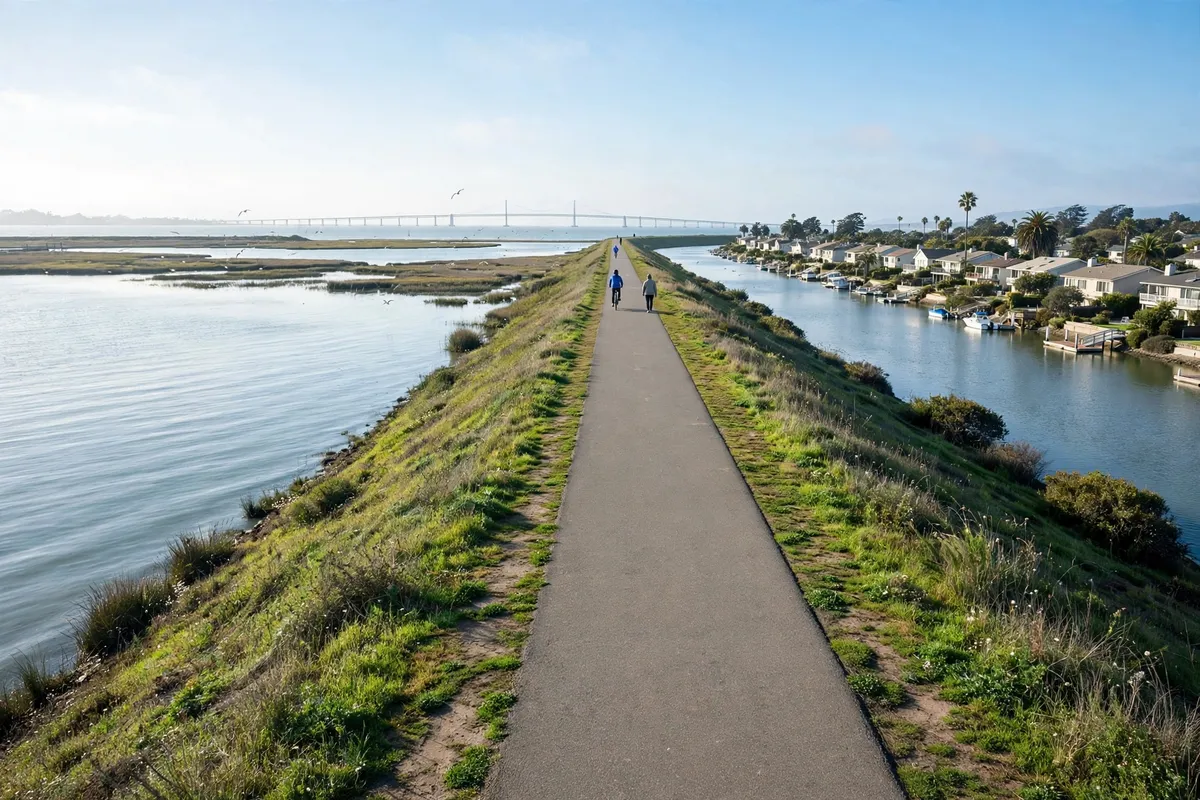
The levee trails circle Foster City and run on along the shore to Redwood Shores and Coyote Point.
Schools, in one view
The school picture by area is covered in the cards above. One warning from experience: school boundaries on the Peninsula can turn on a single street, and this page holds two of the sharpest examples in the series, Redwood Shores answering to a Belmont named district and Menlo Park's three systems inside one small city. Before you offer on any home, we confirm its assigned schools by its exact address, together, in writing. It takes ten minutes and it protects the whole reason many families choose these towns.
Parks and the outdoors
The levee and the lagoons are the backyard here: miles of flat path around Foster City's water, tying into the Bay Trail south to Redwood Shores and north through San Mateo's shore parks to Coyote Point, with its marina, its beach and its science museum for children. Foster City's own lagoon carries paddle boats and dragon boat races in season. For a campus town built on filled bay land, the green and blue around it is the surprise.
Daily life
Each area has a heart you can walk. Downtown San Mateo, the largest of the four. Laurel Street in San Carlos. The courthouse square in Redwood City. Santa Cruz Avenue in Menlo Park. Foster City itself lives quieter, around its lagoons and its library, which suits the households who choose it. Add strong public libraries in every area and weekend sports leagues everywhere, and the ordinary errands of life stay close and easy.
Weekends
The coast at Half Moon Bay sits over the hill on the same highway that serves the campus, the city is up the rail line from three of the four areas, and the bridge opens the East Bay. The levee carries the long rides and the lagoon carries the boats. Families here do not run out of Saturdays.
Questions Visa employees ask
Short answer: the questions below are the ones I hear most, answered the way I answer them in person.
Is Foster City the Visa headquarters?
Not anymore, and it matters for how you think about the move. Visa named San Francisco its global headquarters in 2019, and its Market Support Center at Mission Rock opened in June 2024, with the company calling it the new headquarters as nearly a thousand people moved in. Foster City is the Product and Technology campus, one of the largest Visa sites in the world. If your offer names Foster City, this page is yours. If it names San Francisco, tell me, and we will draw a different map together.
How many people work at the Foster City campus?
Visa does not publish a current campus headcount, and I will not guess one into print. The figure you may meet, about 3,000 people, comes from a 2019 news report about the campus renovation, and it described the capacity the renovated campus was planned to hold, not a count of people working there today. What the company does publish, in its annual filings, is about 34,800 employees worldwide as of September 2026. The honest picture is a very large technology campus whose exact present size the company keeps to itself.
Can I take a train to this campus?
Not to the town itself. Foster City has no rail station. The working pattern is Caltrain to Hillsdale station in San Mateo, then the SamTrans Route 251 bus, which runs about hourly through Foster City to the Metro Center district the campus stands in. It works, and it rewards planning. Households who want the train at the center of daily life usually choose San Mateo or Redwood City and drive or bus the last leg.
How long is the drive from Menlo Park to the campus?
About thirty five to fifty five minutes at peak and twenty to thirty minutes off peak, up 101 and across 92. Judge it against your team's real office days before you let it decide the town: at two or three days a week, many households here accept it for the schools. At five days, most do not, and they land in San Mateo or Redwood City instead.
What does a home near the campus cost?
In round numbers, the median runs from about $1.57M in San Mateo and $1.90M in Redwood City to about $2.48M in San Carlos and $2.95M in Menlo Park, on Redfin figures for the three months ending September 2026. Foster City itself medians near $1.3M across all home types on the same series, because so much of the town is condos and townhomes; its houses trade far higher. All figures are approximate.
Why do the single family numbers here carry a different label?
Because I check them before I print them. For the other pages in this series, the single family column comes from the county association for September 2026. For these four cities, that source's September figures could not be verified, so this page uses the RE Report city medians for October 2026 instead, and says so wherever the numbers appear. A labelled figure from a month later beats an unlabelled one I cannot stand behind.
Can I buy if much of my pay is stock?
In general, yes. Lenders who serve this region see equity pay every day. They look at the pattern of what has vested and landed over time, along with base pay and bonus. Bring the full picture early and let them judge it whole. That is general education; your own lender will give you your own answer.
Does Visa run a shuttle to Foster City?
No public source verifies one, and this page will not promise what it cannot check. Large employers change these arrangements often, and anything that runs for your team will be on Visa's internal pages. Ask in your first week. If a shuttle exists on your route, it can widen the map, and we will redraw it together with that fact in hand.
Which area has the best schools?
Menlo Park and San Carlos carry the names families move for, and their prices say so. San Mateo offers the widest choice inside one city. The honest method is to pick the exact schools first, then find the home inside their lines, and on this corridor that order matters more than anywhere, because the district lines here ignore the city lines completely.
Should I rent first or buy right away?
If you know the Peninsula and your budget is settled, buying right away saves a second move. If you are new, or your campus is not yet settled between Foster City and San Francisco, a season of renting buys knowledge that protects a very large decision. If your move comes with support from your employer, check what it covers before you choose, because it can change the math.
What will my property tax look like?
A little over one percent of your purchase price per year in San Mateo County, resetting to your price when you buy. It is billed in two parts each year, and it is one of the most predictable costs of owning here.
Your first month checklist
Short answer: do these ten things in your first month and the rest of the move gets much easier.
- Confirm which campus your role sits on, Foster City or San Francisco, because it changes the whole map.
- Ask your team its actual office days, and whether any shuttle serves your route, in your first week.
- Ride Caltrain to Hillsdale and the 251 bus into Foster City once, so the rail pattern is a fact and not a line on this page.
- Drive each finalist area at school run hour, then drive it again in the evening.
- Pick the schools that matter to your family and learn their exact boundary lines, starting with the Redwood Shores trap.
- Put your full pay picture, base pay, bonus and vesting, in front of a lender and get approval in writing.
- Set your true top number: the price plus the tax, the insurance and any lagoon side dues that follow it.
- Tour homes in at least two areas on the same day.
- Walk a Foster City lagoon loop and a stretch of levee one weekend morning.
- Save my number now, so the first question costs you nothing to ask.
A word from me
For more than twelve years I have helped families buy and sell homes in these towns, from first homes to grand estates, and I give every home the same care. My clients have left me 104 five star reviews, and the homes I have helped sell here add up to more than $250M. The numbers I trust most are simpler: my phone rings when a past client has a question, years after the keys.
If you are weighing a move to Visa, or a move across the Peninsula, let us talk it through. One call, no pressure, and you will leave knowing the areas, the numbers and the next step. Call me on the Peninsula line at (650) 274 1134 or the South Bay line at (408) 389 6939, or write to me at SIMON@SPSILICONVALLEY.COM.
I am glad you found this page. Wherever you land, welcome to the neighborhood.
Simon Sahi
Real Estate Agent, Signature Properties
CA DRE #01953287

Thinking of buying or selling near the Foster City campus?
Let us talk through the areas, the numbers and your timing, in one honest conversation.
Peninsula (650) 274-1134
South Bay (408) 389-6939