A guide for Applied Materials employees
Working at Applied Materials, living near the Santa Clara campus
You got the job, or the transfer, and now the real question lands: where should you live? This page answers it fully for Applied Materials in Santa Clara and Sunnyvale. The four areas, the drive from each, what homes cost, how the schools sort out, the money, and the road from first tour to keys, all in plain words, all on one page.
I am Simon Sahi, a real estate agent with Signature Properties here in Silicon Valley. I help people buy and sell homes in the towns around these campuses every week, and I built this page so an Applied Materials employee can sit down once and understand the whole picture.
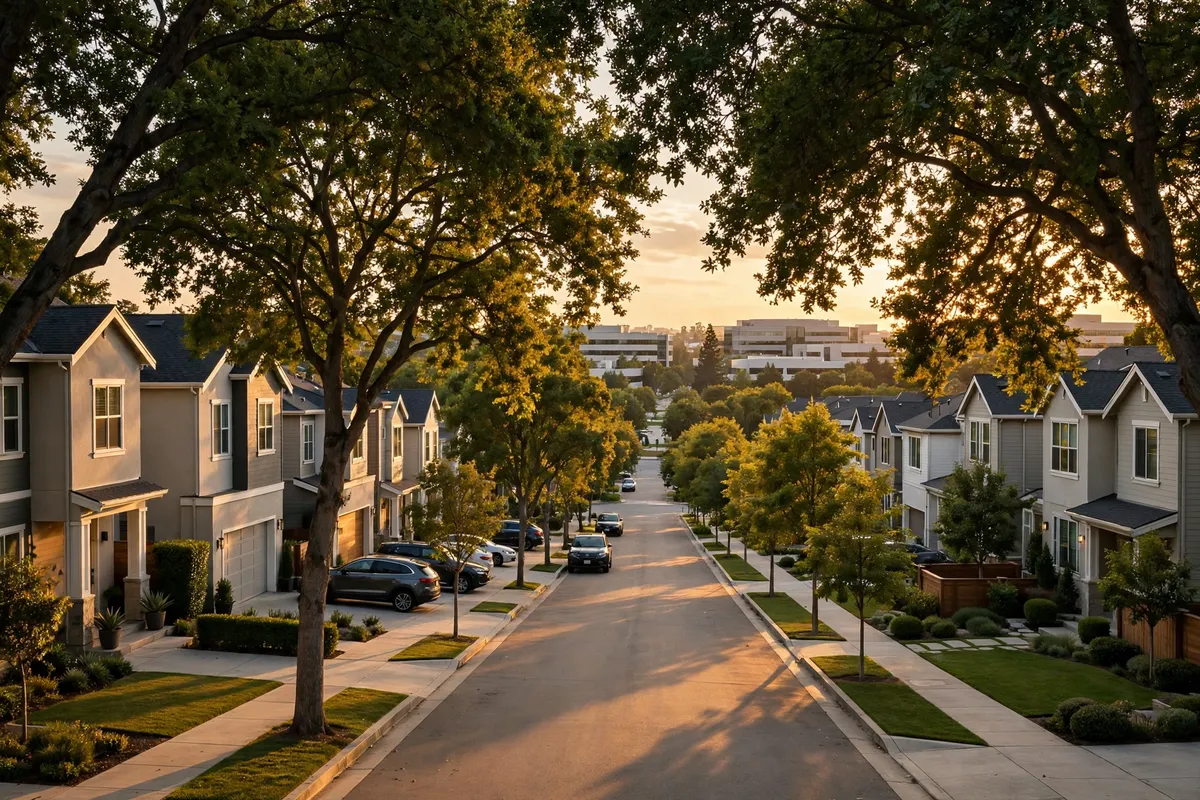
The headquarters campus stands on Bowers Avenue in Santa Clara, and the neighborhoods south of it are streets like this one.
Who this page is for
Short answer: anyone at Applied Materials choosing where to live near the Santa Clara and Sunnyvale campuses, whether you arrive next month or next year.
This page was written for you if:
- You are a new hire moving to the Bay Area and starting from zero.
- You already work at Applied and rent nearby, and you are ready to own.
- Your work could sit at either campus, Bowers Avenue in Santa Clara or Arques Avenue in Sunnyvale, and you want one home that serves both.
- Your family is arriving from another state or another country and needs the full picture in one sitting.
One honest note before we start: Applied Materials works from two campuses a short drive apart. Headquarters is 3050 Bowers Avenue in Santa Clara, and the Arques campus in Sunnyvale is home to the EPIC Center, the big new research building Applied opened in October 2026. Which campus your team sits on matters, and this page is written for both. A large share of the work at both places is laboratory, cleanroom and equipment work that cannot be done from home, so living close carries more weight here than it does at a software only employer.
How to use this page: every section opens with the plain answer, then gives the detail under it. Read the short answers for the whole story in five minutes, or settle into the sections that matter to you. When a question is yours alone, call me and we will work it through.
The short answer
Short answer: Santa Clara itself for the shortest run and the simplest schools, Sunnyvale for the second campus and a strong all round package, San Jose for the lowest median and the most choice, and Cupertino for the schools above all, with every drive on this page inside the three quarters of an hour.
- Shortest run, simplest schools: live in Santa Clara. The campus is in town, one unified district answers the school question in a single lookup, and surface streets do the whole commute.
- The second campus covered: Sunnyvale. If your work sits at Arques Avenue and the EPIC Center, Sunnyvale puts you beside it, and Bowers is still a short run north.
- The lowest median, the most choice: San Jose. The biggest city in the valley starts the four on price, and north San Jose sits close to both campuses.
- The schools above all: Cupertino. The two district picture families move for, at the highest prices of the four and the longest drive of the four.
Something unusual shapes this page: the employer has two front doors, one in Santa Clara and one in Sunnyvale, and the four areas below are arranged around both of them. The rest of this page proves each line of that, area by area, number by number.
The four areas compared
Short answer: all four areas work for campus life at both campuses. They differ in price, schools and feel far more than they differ in minutes, and the Bowers corridor carries one warning the other pages in this series do not: stadium event traffic.
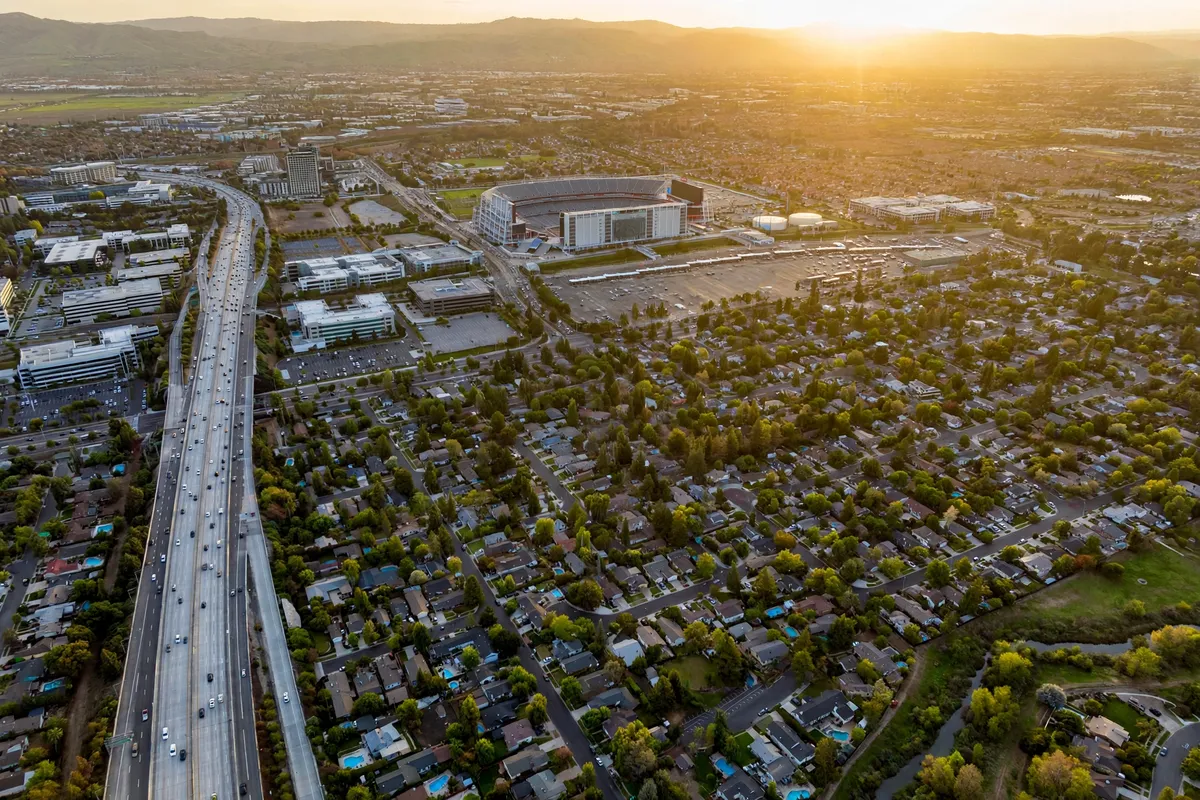
The Bowers corridor stands between the stadium district to the north and the neighborhoods to the south, with four towns fanning out around it.
| Area | Morning drive at peak | Drive off peak | Median price | Single family median | In one line |
|---|---|---|---|---|---|
| Santa Clara | About 15 to 25 minutes | About 10 to 15 minutes | About $1.64M | About $1.82M | The campus city itself, one unified district, surface streets the whole way |
| Sunnyvale | About 20 to 30 minutes | About 10 to 15 minutes | About $1.88M | About $2.82M | Beside the Arques campus and the EPIC Center, strong school paths of its own |
| San Jose | About 25 to 45 minutes | About 15 to 25 minutes | About $1.35M | About $1.57M | The lowest median of the four and the widest choice, north San Jose closest |
| Cupertino | About 25 to 40 minutes | About 15 to 20 minutes | About $2.85M | About $3.21M | The school draw of the valley, at the highest price of the four |
Drive times are typical ranges in a car from the middle of each area to the Bowers Avenue campus, and they stretch on rainy days, school mornings and event days at the stadium up the same corridor. The San Jose range is wide because the city is wide: north San Jose sits at the near end of it and the southern districts at the far end. Prices are approximate medians from Redfin for all home types across the three months ending September 2026. The single family median column gives the median for houses alone in September 2026 from county association figures, because no source publishes a verified top tier price for these cities and none is invented here.
Santa Clara
The campus city itself: established neighborhoods south of the campus, one unified school district, and a commute with no freeway in it.
The drive. About fifteen to twenty five minutes at peak from most neighborhoods, up Bowers Avenue, Kiely Boulevard or San Tomas Expressway, and ten to fifteen minutes off peak. From the Tasman district north of the freeway the run is shorter still outside event hours, down Great America Parkway to the same campus gates.
The homes and prices. Ranch neighborhoods from the orchard years, the Old Quad near the university, and condo and townhome rows along the Tasman corridor. The citywide median sits at about $1.64M across all home types, and single family homes alone median about $1.82M, the smallest step up of the four areas, which tells you how much of this city is houses. Condos and townhomes near the stadium district form the first rung.
The schools. Santa Clara Unified serves most of the city from kindergarten through twelfth grade in one district, with Santa Clara High, Wilcox High and the new MacDonald High among its high schools. One lookup answers the whole school question, the simplest picture on this page. Small pockets at the city edges answer to other districts, so the address check still applies.
The feel. A working city with an old heart: the Old Quad streets, the university beside them, and the stadium district glowing to the north. The neighborhoods south of El Camino Real live quiet, and the creek trail ties them together.
Who it suits. Anyone who wants the shortest day and the simplest school answer, from first time valley buyers to families who plan to stay.
Sunnyvale
The second campus city: home of the Arques campus and the EPIC Center, with a wide spread of homes and school paths all its own.
The drive. About twenty to thirty minutes at peak to Bowers Avenue, up Lawrence Expressway or Central Expressway, and ten to fifteen minutes off peak. To the Arques campus the run is shorter still, because that campus stands in Sunnyvale itself, off Lawrence Expressway and Central Expressway.
The homes and prices. Ranch neighborhoods, townhome rows, and some of the most contested single family streets in the valley. The citywide median sits at about $1.88M across all home types, and single family homes alone median about $2.82M, a large step up that tells you how contested the houses are. Homes here draw several offers and sell over asking as a habit.
The schools. Most of Sunnyvale reads Sunnyvale School District for the younger years and Fremont Union for high school, Fremont High or Homestead High by address. The southwestern pockets read Cupertino Union instead, and northern slices can fall in Santa Clara Unified. Three different answers inside one city, so verify by exact address.
The feel. A working tech city with a revived downtown on Murphy Avenue, orchards in its memory and the bay at its back. It is the most central address in Silicon Valley, and the neighborhoods live quieter than that fact suggests.
Who it suits. Anyone whose work sits at Arques Avenue, and dual campus households who want one home that serves the EPIC Center today and Bowers Avenue tomorrow.
San Jose
The big city to the east and south: the lowest median of the four, the widest choice, and a commute that depends entirely on which part of the city you pick.
The drive. From north San Jose, about twenty five to thirty five minutes at peak on 880 and 237 or up First Street and Tasman Drive. From downtown and Willow Glen, about thirty five to fifty minutes at peak on 880 or 280 and Lawrence Expressway. Off peak the whole city sits inside fifteen to twenty five minutes. Pick your district with the drive in mind, because San Jose is not one commute.
The homes and prices. Everything exists here, from downtown condos to Almaden Valley estates. The citywide median sits at about $1.35M across all home types, the lowest of the four, and single family homes alone median about $1.57M. A citywide median hides large differences between districts, so before any offer we price the real home against the recent sales on its own street.
The schools. San Jose is served by more than a dozen districts, and a San Jose address alone tells you almost nothing. The central and northern parts read San Jose Unified, the west side can read Cupertino Union and Fremont Union, and the north can read Santa Clara Unified. This is the city where the address check matters most.
The feel. A real city, with a downtown, a stadium of its own, Willow Glen's main street, the Rose Garden streets and Almaden's foothill calm, all inside one set of borders. No other area on this page offers so many different lives at so many different prices.
Who it suits. Buyers who put choice and price first and accept a longer run, and north San Jose buyers who want the city median with a campus distance drive.
Cupertino
The school draw of the valley: two famous districts, garden suburbs, and the highest prices of the four areas.
The drive. About twenty five to forty minutes at peak, up Lawrence Expressway from 280 or across on 85 and 237, and about fifteen to twenty minutes off peak. Lawrence Expressway is the slow leg at peak, and every Cupertino household learns its moods in the first month.
The homes and prices. Ranch homes on quiet streets, eichlers, and newer builds behind hedges. The citywide median sits at about $2.85M across all home types, the highest of the four, and single family homes alone median about $3.21M. Condos and townhomes along the Stevens Creek corridor form the first rung, and they are contested too.
The schools. Cupertino Union serves kindergarten through eighth grade, then Fremont Union for high school: Cupertino, Monta Vista, Lynbrook, Homestead or Fremont High by exact address. One warning worth printing in bold in your own notes: a Cupertino address does not by itself mean Monta Vista. The boundary, not the city name, decides.
The feel. A garden suburb built around its schools, with a growing main street on Stevens Creek Boulevard, the hills of Rancho San Antonio at its western edge and a calm that deepens street by street.
Who it suits. Families who put the schools first and accept the longest drive of the four as the price of them.
Getting to campus
Short answer: most people drive a short run on the expressways, and the honest transit picture is a bus and trail story, not a light rail one. One correction matters: the light rail runs north of the freeway, and it does not come down Bowers Avenue to the campus.
By car
The Bowers campus stands at the Highway 101 exit for Bowers Avenue and Great America Parkway, with Scott Boulevard at its north edge and Central Expressway at its south. Lawrence Expressway is the second artery and the primary one for the Arques campus in Sunnyvale. From the East Bay, 880 south to 237 west brings you to the same corridor. From the south, 280 to Lawrence Expressway runs straight at both campuses.
One warning belongs in every plan: the campus sits on the same Bowers and Great America Parkway corridor that serves the stadium and the theme park north of the freeway. On game days and major event days that corridor carries event traffic on top of the commute. A home north of 101 lives inside that pattern. A home south of Central Expressway mostly avoids it.
By light rail and bus, honestly
The light rail runs along Tasman Drive, north of Highway 101, through the stadium district: Old Ironsides, Great America and Lick Mill are the stations on this side of the valley, served by the Orange and Green lines. No line runs down Bowers Avenue. The campus connection is the bus: VTA lines 57 and 58 run on Bowers Avenue itself, tying the campus to the Great America station and to the neighborhoods south of it. So the honest rail commute is light rail to Tasman, then a bus or a bike for the leg south across the freeway.
For train riders, Lawrence station is the closest Caltrain stop to the campus, a bike, bus or short drive last leg, and Santa Clara station is the fuller hub, with Caltrain, the Capitol Corridor and the ACE train from the East Bay and the Tri Valley side. The ACE and Capitol Corridor stop at the Great America station by the stadium, a bus ride north of the campus on the same parkway.
By bike
The San Tomas Aquino Creek Trail is the spine here: about eight miles of paved, mostly grade separated trail along the creek through Santa Clara, with ramps at Scott Boulevard and Central Expressway inside the campus street grid. Residential Santa Clara south of El Camino Real can ride it north to the campus without riding Bowers Avenue itself, and it connects onward to the Bay Trail toward the Sunnyvale Baylands and Alviso. The Arques campus is reached on surface bike lanes along Lawrence Expressway and Arques Avenue rather than by the trail.
Shuttles and shared rides
Large valley employers move people in many ways, and arrangements differ by company and by team. Here is the honest part: any shuttle or ride benefit tied to your job lives on Applied Materials internal pages, and it can change as teams and buildings change, so no outside page can print it for you, this one included. Treat it as a first week question. Ask your team what runs near a home you like before you fall for the home, and tell me what you learn. While we search, we will weigh it alongside the trail, the schools and the price.
The money picture
Short answer: the gentlest starting point in this set is San Jose, and the widest spread sits between the all homes median and houses alone in Sunnyvale and Cupertino. Wherever you land, plan the whole cost of owning, not just the purchase price.
What homes cost by area
In round numbers, from Redfin figures for the three months ending September 2026: San Jose starts the four at a median of about $1.35M, then Santa Clara at about $1.64M, Sunnyvale at about $1.88M, and Cupertino at about $2.85M. Single family homes alone run higher everywhere: about $1.57M in San Jose, $1.82M in Santa Clara, $2.82M in Sunnyvale and $3.21M in Cupertino in September 2026. Below the medians sit the condos and townhomes that form the first rung in every town, medianing near $729,000 in San Jose, $750,000 in Santa Clara and $1,250,000 in Sunnyvale that month. A median is a middle marker, not a quote, so before any offer we price the real home against the recent sales on its own street.
Buying while paid partly in stock
At Applied Materials, as across the valley, a real share of pay can arrive as stock that vests over time rather than as salary. Lenders here understand that shape of pay because they see it every working day. In general terms, they study your base salary, your bonus pattern, and the record of stock that has already vested and landed across the past couple of years, and they treat a steady vesting record as part of your income picture. Stock that has not vested yet generally counts for less than stock that has a history of landing.
So build one folder early: your offer letter, your pay records, and your vesting schedule. Put the whole picture in front of a lender who works with tech pay before you fall for a home, not after. One more honest note: Applied reshaped its workforce in late 2025, cutting about four percent of its global staff, with notices covering roles in Santa Clara and Sunnyvale, as most large employers here have at some point. A household buying on one Applied income does itself a favor by keeping a reserve after the down payment rather than stretching to the last dollar. This is general education only, never a promise about any loan. Your own numbers will decide what you can carry, and a straight talking lender will lay them out plainly.
Renting first or buying first
Renting first suits you if you are new to the valley and want a season of living here before a decision this size, if you want to learn which campus your work truly sits on before you buy near it, or if a large share of your pay lands later in the year and you want it counted at full strength.
Buying first suits you if you already know these towns, if your family wants one move and then roots, or if you would rather build your own equity from the first month than pay a landlord through a long search.
Neither order is the right one for everyone. What protects you is choosing on purpose, with the numbers in front of you, instead of drifting into whichever lease or listing shows up first.
Closing costs and taxes, the basics
Closing costs. Beyond your down payment, allow roughly one to two percent of the price for the bundle of loan, title, escrow and recording charges. The exact figure depends on the loan and the home.
Property tax. In Santa Clara County the yearly tax runs at about 1.2 percent of the purchase price, and it resets to your price when you buy. It is billed in two parts each year, and it is one of the most predictable costs of owning here.
Insurance. Lenders require home insurance, and the price follows the home and its setting. Older homes and homes under big trees can cost more to insure than newer homes on open lots.
Monthly dues. Condos and townhomes carry monthly association dues that cover shared costs. Single family homes in these four areas usually have no dues, or small ones.
These are the shapes of the costs, in general educational terms. For advice on your own taxes and money, sit with your own tax professional; for the numbers on a real home, sit with me.
The buying journey on a relocation timeline
Short answer: from first tour to keys in hand most often takes about two to four months here. The steps below show the shape of it, in order.
- Weeks one and two: learn the ground. Settle in at work and learn which campus your team truly sits on, Bowers Avenue or Arques Avenue. Drive the areas at school run hour and again at seven in the evening, and drive the Bowers corridor once on a stadium event day so you know that pattern cold. Write down what your family will not give up.
- Line up the money. Talk with a lender early, put your full pay picture in front of them, equity included, and get your approval in writing. Sellers across these areas expect to see it with the offer.
- Tour with purpose. See homes in two or three areas on the same day, so the trade between price, space and drive becomes real instead of theoretical.
- Watch the rhythm. New homes land through the week and most open homes run on weekends. Santa Clara and San Jose homes have been moving in about three weeks lately, while the best Cupertino homes still go in about two. We set our pace by the area, not by habit.
- The offer. Price is only the start. In San Jose you may have room to negotiate terms that Cupertino would never grant, and we will study the recent sales on the street before we set your number, so the offer fits the market it lands in.
- Closing. Once an offer lands, closing usually runs about three to four weeks, with inspections, the appraisal and the loan work packed inside it.
- Keys and settling. Move in, set up the trail run or the school run, and breathe. My help does not end at the keys. Call me for the plumber, the gardener, or the permit question.
Family life in the four areas
Short answer: families thrive across all four areas. Schools lead the decision, and a creek trail, the bay shore and four real main streets fill the rest of life.
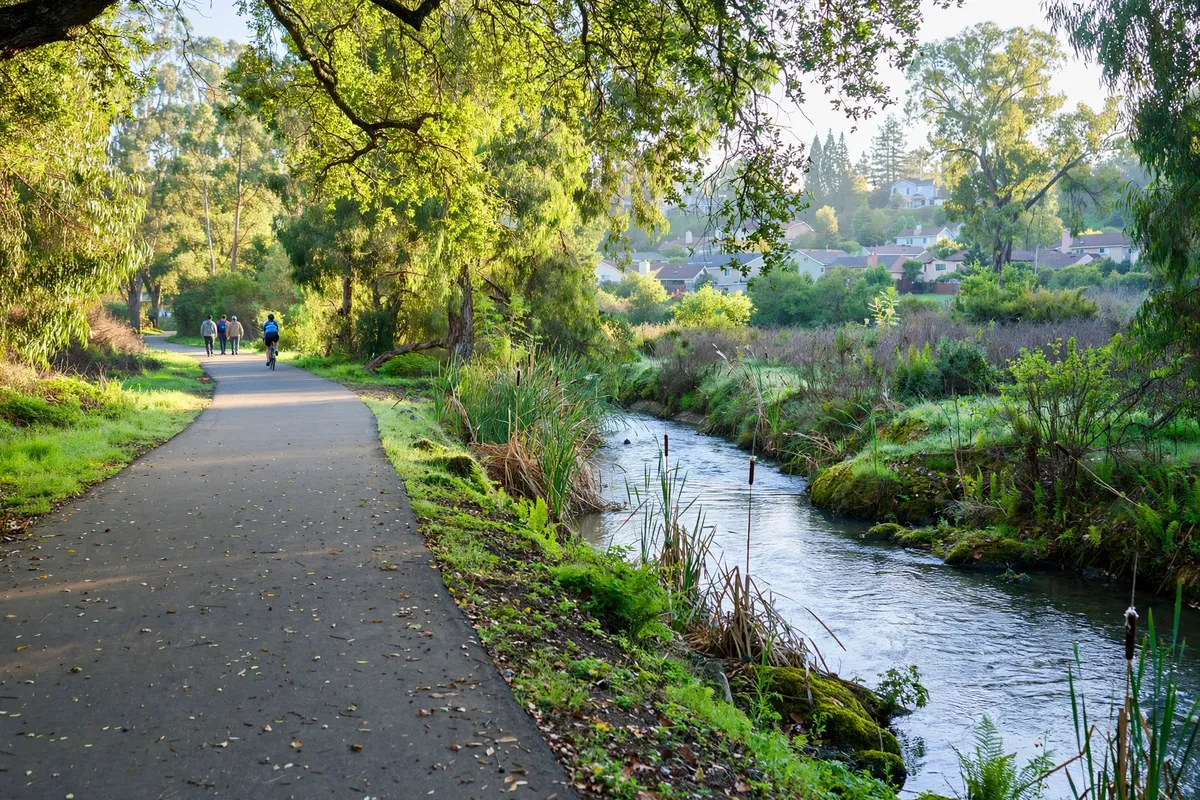
The San Tomas Aquino Creek Trail runs the length of Santa Clara, from the southern neighborhoods to the bay, past the campus street grid.
Schools, in one view
The school picture by area is covered in the cards above. One warning from experience: school boundaries here can turn on a single street, and two homes that look identical on a map can feed different schools. Sunnyvale, with its three different answers inside one city, is the sharpest example on this page. Before you offer on any home, we confirm its assigned schools by its exact address, together, in writing. It takes ten minutes and it protects the whole reason many families choose these towns.
Parks and the outdoors
The San Tomas Aquino Creek Trail runs about eight miles through Santa Clara and connects to the Bay Trail, which carries riders and walkers along the shore toward the Sunnyvale Baylands and Alviso. Central Park in Santa Clara serves the neighborhoods south of the campus, and the bay shore itself is the weekend edge of both Santa Clara and Sunnyvale. Cupertino adds the Rancho San Antonio open space at its western edge, where the whole valley goes to walk.
Daily life
Each area has a heart you can walk. The Old Quad and El Camino Real in Santa Clara. Murphy Avenue in Sunnyvale. Main Street in Cupertino, growing year by year. Lincoln Avenue in Willow Glen and downtown San Jose a short run east. Add strong public libraries in every area and weekend sports leagues everywhere, and the ordinary errands of life stay close and easy.
Weekends
The coast over the hills and the city up the rail line both sit inside an easy day. The stadium and the theme park beside the Tasman district fill event nights a few minutes from the campus, the bay trails carry the long rides, and the foothill trails carry the hikers. Families here do not run out of Saturdays.
Questions Applied Materials employees ask
Short answer: the questions below are the ones I hear most, answered the way I answer them in person.
Where do Applied Materials employees live?
Across Santa Clara first of all, in the neighborhoods south of the campus and the condo rows along Tasman Drive, then Sunnyvale around the Arques campus, and out into San Jose and Cupertino as budgets and school plans decide. The pattern follows three things: which campus the work sits on, the schools, and the budget.
How many people work at the Santa Clara campus?
Applied Materials does not publish an exact campus total. California state employer data, from the California EDD, lists Applied Materials at its 3050 Bowers Avenue, Santa Clara address in the 5,000 to 9,999 employee size class. That is a band from the state employer database, not a company count, and I would rather give you that with its label on it than a round number I cannot stand behind. News reporting in October 2025 put the Bay Area total at nearly 6,000, labelled as a news estimate.
What is the EPIC Center, and does it change where I should live?
The EPIC Center is Applied's new research building on its Arques campus in Sunnyvale, about 600,000 square feet with more than 180,000 square feet of cleanroom space, opened in October 2026 at a cost Applied puts at about $5 billion. If your work touches it, Sunnyvale and the Lawrence Expressway corridor deserve a place on your list alongside Santa Clara. Ask your team which campus your role sits on before we draw the search map.
Can I take light rail to the campus?
Not to the door, and any page that promises it is reading the map too hopefully. The light rail runs along Tasman Drive north of Highway 101, through the stadium district. The campus connection is the VTA bus: lines 57 and 58 run on Bowers Avenue itself. The working rail commute is light rail to the Tasman stations, then the bus or a bike south across the freeway, or Caltrain to Lawrence station with a short last leg.
How long is the drive from Cupertino to the campus?
About twenty five to forty minutes at peak and fifteen to twenty minutes off peak, up Lawrence Expressway. Judge your own run once at your real start time before you let it decide a town, and try the 85 and 237 route as well, because the better road depends on which side of Cupertino you start from.
What does a home near the campus cost?
In round numbers, the median runs from about $1.35M in San Jose and $1.64M in Santa Clara to about $1.88M in Sunnyvale and $2.85M in Cupertino, on Redfin figures for the three months ending September 2026. Condos and townhomes start well below those medians, and single family homes run well above them. All figures are approximate.
Does the stadium change daily life near the campus?
On event days, yes. The stadium and the theme park sit north of the freeway on the same Bowers and Great America Parkway corridor as the campus, and game days stack event traffic on top of the commute. Homes south of Central Expressway mostly dodge it. Homes in the Tasman district live inside it, and some people love that. Know which buyer you are before you choose that side of the freeway.
Can I buy if much of my pay is stock?
In general, yes. Lenders who serve this valley see equity pay every day. They look at the pattern of what has vested and landed over time, along with base pay and bonus. Bring the full picture early and let them judge it whole. That is general education; your own lender will give you your own answer.
Which area has the best schools?
Cupertino sits at the very top of most rankings, and its prices say so. Santa Clara offers the simplest picture, one unified district in a single lookup. Sunnyvale varies by pocket, with Fremont Union high schools as its backbone. The honest method is to pick the exact schools first, then find the home inside their lines.
Should I rent first or buy right away?
If you know the valley and your budget is settled, buying right away saves a second move. If you are new, a season of renting buys knowledge of the towns, and of which campus your work truly sits on, that protects a very large decision. If your move comes with support from your employer, check what it covers before you choose, because it can change the math.
What will my property tax look like?
About 1.2 percent of your purchase price per year in Santa Clara County, resetting to your price when you buy. It is billed in two parts each year, and it is one of the most predictable costs of owning here.
Your first month checklist
Short answer: do these ten things in your first month and the rest of the move gets much easier.
- Confirm which campus your role sits on, Bowers Avenue or Arques Avenue, because it moves the center of the search map.
- Drive the Bowers corridor once on a stadium event day, so the event pattern is a fact and not a surprise.
- Ride the San Tomas Aquino Creek Trail once, and drive the same trip at peak, so you know both of your options cold.
- Drive each finalist area at school run hour, then drive it again in the evening.
- Pick the schools that matter to your family and learn their exact boundary lines.
- Put your full pay picture, base pay, bonus and vesting, in front of a lender and get approval in writing.
- Set your true top number: the price plus the tax and insurance that follow it.
- Tour homes in at least two areas on the same day.
- Spend one weekend morning on the main street of each finalist area.
- Save my number now, so the first question costs you nothing to ask.
A word from me
For more than twelve years I have helped families buy and sell homes in these towns, from first homes to grand estates, and I give every home the same care. My clients have left me 104 five star reviews, and the homes I have helped sell here add up to more than $250M. The numbers I trust most are simpler: my phone rings when a past client has a question, years after the keys.
If you are weighing a move to Applied Materials, or a move across town, let us talk it through. One call, no pressure, and you will leave knowing the areas, the numbers and the next step. Call me on the Peninsula line at (650) 274 1134 or the South Bay line at (408) 389 6939, or write to me at SIMON@SPSILICONVALLEY.COM.
I am glad you found this page. Wherever you land, welcome to the neighborhood.
Simon Sahi
Real Estate Agent, Signature Properties
CA DRE #01953287

Thinking of buying or selling near the Bowers Avenue campus?
Let us talk through the areas, the numbers and your timing, in one honest conversation.
Peninsula (650) 274-1134
South Bay (408) 389-6939